Negotiation Strategy
Plus & ProTurn the score and the market into a negotiation brief — where the price really sits, and how to move it.
What is the Negotiation Strategy?
A listing had weeks to polish its price. The Negotiation Strategy is an AI-prepared brief for one specific home on a Home mission: it reads the womiin Score behind the location, the market intelligence for the area, the listing details, and the comparable homes in your mission — and turns all of it into an actionable case for the table.
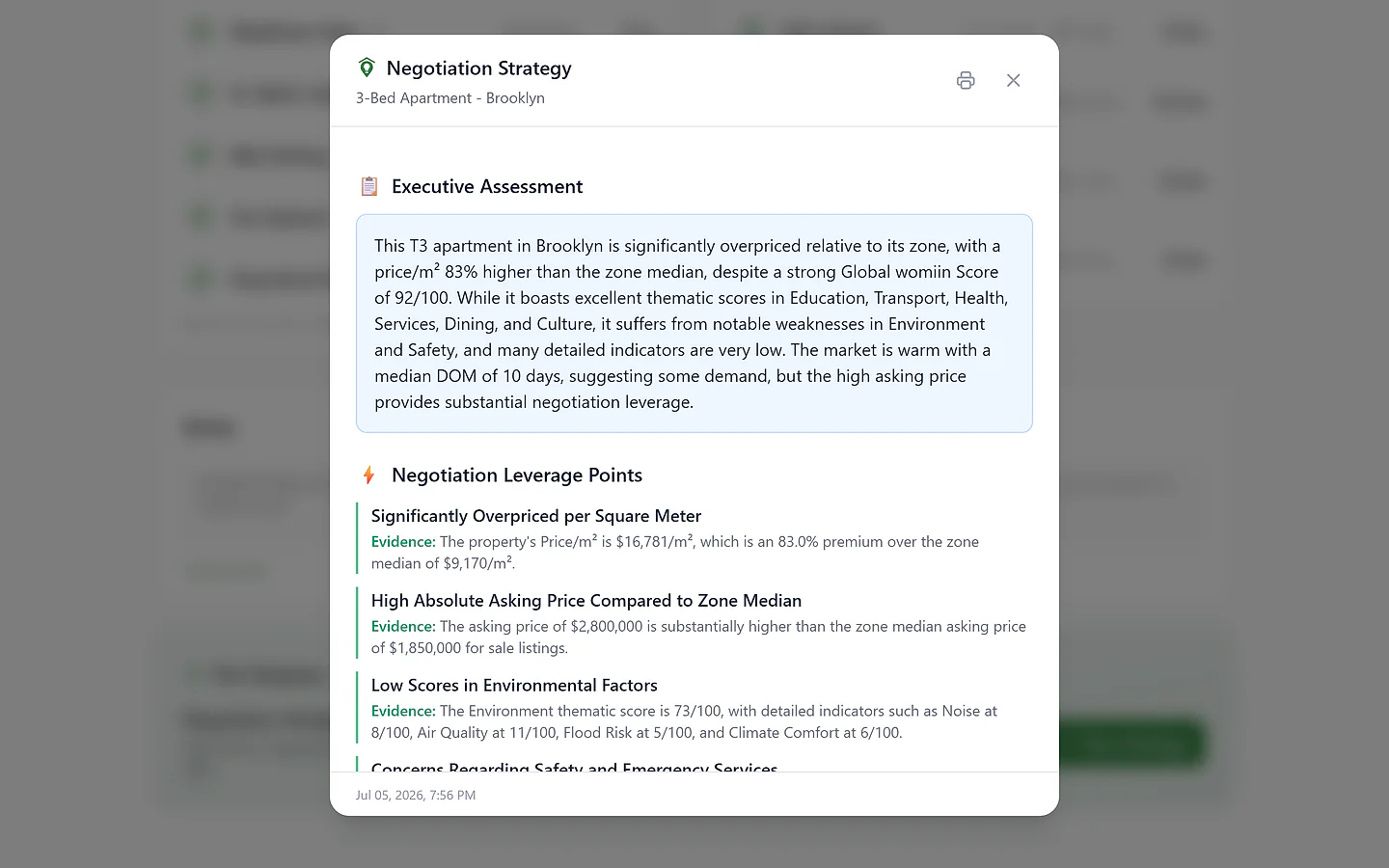
The brief, before the offer
The Brooklyn home, read as a buyer — 83% over the zone, with the offer range to prove it.
You choose a side. The buy-side brief (Plus and Pro) reads the property as the buyer or tenant — leverage points, a fair-price estimate, the risks. The sell-side perspective (Pro) reads it from the other side of the table — the selling points, the price justification, the objections to expect. Every claim is tied back to womiin's data, so you walk in with evidence, not adjectives.
Data-backed, not guessed
Every leverage point and price estimate is traced to a number — the zone median, the score, the days on market — not a gut feeling.
Both sides of the table
Read the property as a buyer, or (on Pro) flip to the seller's view. Understanding the other side's case makes yours stronger.
A fair number, with reasons
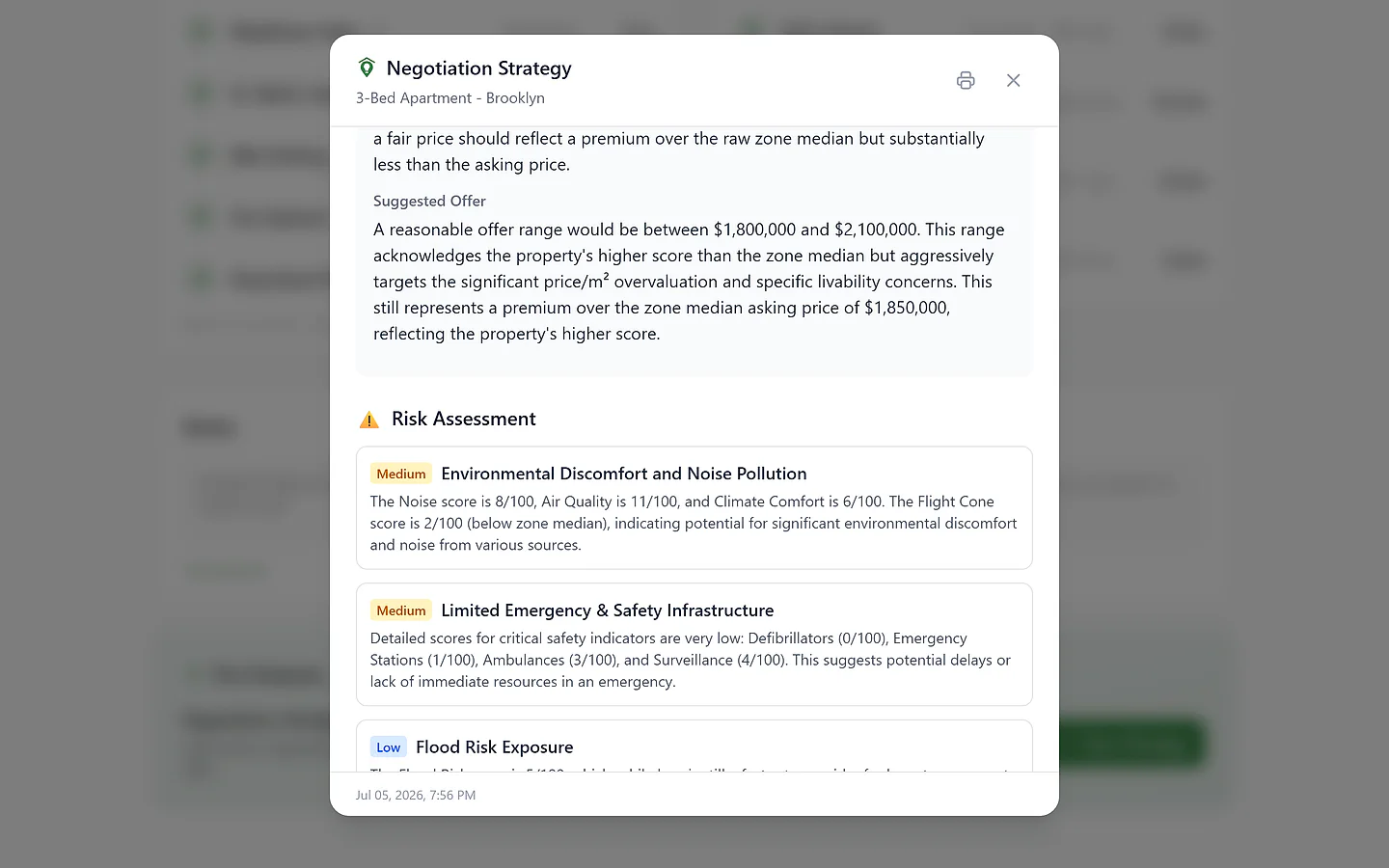
The buy-side brief lands on a fair-price range and an opening offer, each justified against the market and the property's own strengths and weaknesses.
Two sides of the same table
Both perspectives read the same home on a Home (buy or rent) mission — a Travel trip is planned with the Itinerary instead.
Buy-side strategy
Buyer / tenant
Read the property as the buyer: where the asking price really sits, the leverage the data hands you, a fair-price estimate, the risks, and comparable alternatives already in your mission.
- Plans
- Plus & Pro
- You get
- Executive assessment · leverage points · fair-price estimate · risk assessment · comparable alternatives · recommended approach
Sell-side perspective
Seller / landlord
See the same home from the other side — the strongest selling points, a price justification against the market, the buyer profile it fits, and the objections to expect, with answers ready.
- Plans
- Pro
- You get
- Executive summary · key selling points · price justification · target buyer profile · weaknesses & counters · recommended approach
How a strategy is built
Pick a home
From a scored home's page in a Home (buy or rent) mission, the Negotiation Strategy is one click away — Travel missions use the Itinerary instead.
How people use it
The Martins make an offer
House hunt · NYC: the Redfin home the Martins keep circling asks $2.8M and scores 92 — but its price per m² runs 83% over the zone median. The buy-side brief turns that into leverage: a fair-offer range of $1.8M–$2.1M, the high condo fee and the low Environment scores as counter-points, and two cheaper comparables already in their own mission.
Result: They walk into the offer with an opening number and the data behind it — not a hunch.
A seller sets the price
Preparing to list, a Pro user flips to the sell-side perspective on their own home. It surfaces the strongest selling points from the score, a price justification against the local market, the buyer profile the home fits, and the objections a buyer is likely to raise.
Result: They set the asking price and rehearse the answers before the first viewing.
A first-time buyer, steadier
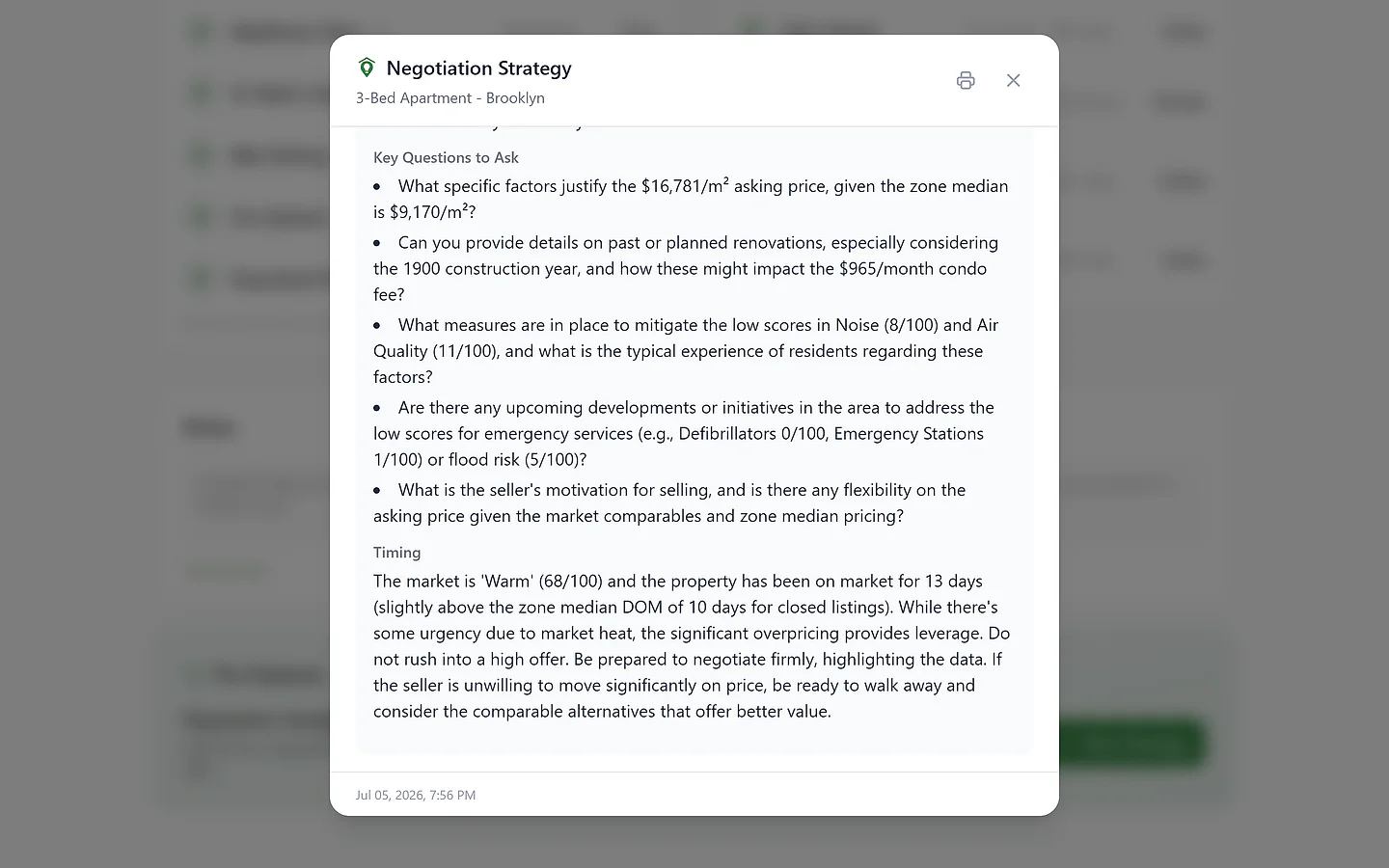
David has never negotiated a home and doesn't know where to push. The buy-side brief hands him the leverage points, a fair-price estimate, and a recommended opening approach — the questions a seasoned buyer would ask, in order.
Result: He negotiates from evidence, not nerves.
See it in action
Plans & limits
| Feature | Free | Plus | Pro |
|---|---|---|---|
| Buy-side strategy | No | Yes · Better than Free | Yes |
| Sell-side perspective | No | No | Yes · Better than Plus |
| Strategies (rolling 30 days) | — | 3 · Better than Free | 10 · Better than Plus |
| Print / PDF export | No | No | Yes · Better than Plus |
Strategies run on a rolling 30-day allowance. On a shared mission, whoever generates one uses their own plan and allowance — your own plan decides which perspectives you can run.
Works with
womiin Score
The score's strengths and weaknesses become the brief's leverage points.
Market intelligence
Where the price sits against the zone — the backbone of the fair-price estimate.
Comparison
The comparable alternatives in the brief come from your mission's other homes.
Itinerary
Travel's counterpart — a stay is planned, not negotiated.
Questions
What is the Negotiation Strategy?
An AI-generated brief that turns the womiin Score, market intelligence, listing details and comparable homes into actionable negotiation advice. It's available on Plus (buy-side) and Pro (both sides) for Home (buy or rent) missions.
Why do I see a buy and a sell option?
Every negotiation has two sides. The buy-side brief gives you leverage points and a fair-price estimate as the buyer; the sell-side perspective shows the seller's case and likely objections. Buy-side comes with Plus and Pro; the sell-side perspective is Pro only.
Does it work for Travel missions?
No. The Negotiation Strategy is built for Home missions (buy or rent), where negotiation applies. On a Travel mission its counterpart is the day-by-day Itinerary — use that to plan a stay.
How many strategies can I generate?
Plus includes 3 and Pro 10 per rolling 30-day window, counted across all your missions — a strategy generated 31 days ago no longer counts. Each perspective you generate counts separately.
Can I regenerate a strategy?
Yes. If newer market data is available or the listing has changed, regenerate for a fresh brief — the new one replaces the previous one for that perspective and counts toward your rolling 30-day allowance.
On a shared mission, whose plan and limit apply?
Your own. When you generate a strategy on a mission you collaborate on, your effective plan decides which perspectives you can run (sell-side needs your own Pro), and each generation counts against your own rolling 30-day allowance — not the owner's. Viewers can't generate; you need an editor or owner role.
What if there isn't enough market data for the area?
Then the brief is built without a market benchmark — and it's told to flag that gap rather than speculate around it. The market read is an aggregate over the area, and it only reaches the brief once there are enough comparable listings behind it; the lookup widens to progressively larger areas around the property before giving up. Without one, the brief still works from the womiin Score and the listing itself, and a buy-side brief can also draw on the other scored homes already in your mission. We'd rather hand you less than anchor a negotiation on a number the data doesn't support.
Ask me anything about the Negotiation Strategy
An assistant that answers questions about this feature, in your words.
Ask in any language — we'll reply in yours.
Bring the numbers to the table
It's free to start with the full womiin Score — and bring in the Negotiation Strategy with Plus when an offer is in sight.